Massage therapy may provide short-term improvements in pain, stiffness, comfort or movement for some people with uncomplicated low back pain. However, individual responses vary, and massage does not address every possible cause of back pain. It is generally best considered as one option within a broader plan that may also include comfortable activity, education, self-management and another form of clinical care when appropriate.
Massage should not be the first step when low back pain follows major trauma or occurs with new bowel or bladder changes, numbness around the groin or saddle area, fever, progressive weakness or other concerning symptoms. Those situations require medical or urgent assessment.
If you are considering massage therapy for low back pain in Edmonton, a helpful decision begins with three questions: Are there signs that need medical attention? Does massage fit your goals and preferences? Is the plan helping you do more of what matters in daily life?
Can Massage Therapy Help Low Back Pain?
The Short Answer
Massage may help some people feel more comfortable, less stiff or more confident moving. These effects can make daily activity, sleep, work or exercise feel more manageable. Benefits are not guaranteed, and symptom relief does not necessarily mean that a specific structure has been repaired or that the underlying reason for pain has been identified.
Research generally suggests that massage can offer modest, often short-term benefits for certain people with low back pain. Results differ among studies, and improvements in pain are not always accompanied by equally large improvements in function. What matters clinically is not only whether a pain score changes, but whether the person can sit, walk, sleep, work, train or complete daily tasks more comfortably.
Why Responses Vary
Low back pain is not one uniform condition. A recent episode after unusual activity can behave differently from recurring pain or symptoms that have persisted for months. Sleep, stress, physical workload, general health, previous experiences, expectations and concerns about movement can all influence how pain is experienced.
Massage preferences also differ. One person may find broad, gentle pressure calming, while another may prefer more focused work. A technique that feels helpful during one stage of recovery may be too intense during another. Effective care should therefore be adapted to the person rather than based on a fixed routine.
Massage as Part of a Broader Plan
Massage is often most useful when it supports active recovery rather than replacing it. Temporary symptom relief may create an opportunity to resume walking, participate in an exercise plan, tolerate work tasks or sleep more comfortably. It should not create the impression that the back is fragile or that regular hands-on treatment is always necessary to remain well.
Human Integrated Performance serves Edmonton residents within a multidisciplinary, human-performance setting. That perspective is useful when low back pain affects more than pain intensity, including work capacity, training, recreation, sleep or confidence in movement. The appropriate plan depends on the individual and may involve massage alone for a limited period, self-management or assessment by another qualified health professional.
When Low Back Pain Needs Medical Assessment First
Most low back pain is not caused by a dangerous condition, but some symptom patterns require timely assessment. Red flags cannot diagnose a condition on their own; they must be interpreted alongside health history, examination findings and how symptoms are changing.
Seek Emergency Assessment
Call 911 or go to an emergency department when low back pain is associated with a possible medical emergency. Concerning combinations include:
- New loss of bladder or bowel control, or difficulty beginning or sensing urination.
- New numbness around the genitals, buttocks or inner thighs, sometimes described as saddle-area numbness.
- Rapidly developing or progressive weakness in one or both legs.
- Severe symptoms after major trauma, such as a significant collision or fall.
- Back pain accompanied by symptoms of a broader emergency, such as severe illness, collapse, chest pain or difficulty breathing.
Bladder or bowel changes, saddle-area sensory loss and progressive leg weakness can occur with serious compression of nerves at the base of the spine. This is uncommon, but the consequences of delay can be significant. Massage is not an appropriate substitute for emergency assessment.
Arrange Prompt Medical Review
Other circumstances may not always be emergencies but should be discussed promptly with a physician, nurse practitioner or appropriate medical service:
- Fever, chills or feeling systemically unwell with new back pain.
- Unexplained weight loss or other unexplained systemic changes.
- A history of cancer, significant immune suppression or a recent serious infection.
- Back pain after trauma, particularly when bone health may be reduced.
- New or worsening leg weakness, altered walking or substantial changes in sensation.
- Severe, unremitting or worsening pain that does not change with position.
- New night pain that is persistent, unexplained or accompanied by other concerning symptoms.
Night pain by itself does not establish a serious diagnosis. Many people with uncomplicated back pain have difficulty sleeping because changing position hurts. The broader pattern, medical history and progression determine how concerning a symptom may be.
Health Information to Disclose Before Massage
Tell the massage therapist about recent surgery or injury, pregnancy, osteoporosis, bleeding or clotting concerns, blood-thinning medication, skin infection, loss of sensation, significant medical conditions and any current medical investigation. This information may affect positioning, pressure, areas treated or whether massage should be postponed.
If you are uncertain how urgently you need care in Alberta, Health Link 811 can provide health advice and help identify an appropriate next step. Call 911 for an emergency. When symptoms are changing quickly or seem medically concerning, it is safer to seek assessment than to use massage as a test.
Which Types of Low Back Pain May Be Reasonable to Discuss With a Massage Therapist?
Massage may be reasonable to discuss for recent, recurring or persistent low back pain when urgent concerns have been excluded and touch-based care fits the person’s preferences. Common examples include back discomfort associated with stiffness, guarded movement, a change in physical workload, prolonged positions or a return to activity.
Recent, Recurring and Persistent Pain
Low back pain is often described according to duration, although exact time categories can differ among guidelines. Recent pain has been present for a relatively short period, while persistent or chronic pain continues for months. Recurrent pain refers to episodes that return after a period of improvement.
Duration alone does not determine whether massage is appropriate. Recent, highly irritable pain may call for gentle positioning and limited pressure, if massage is used at all. With persistent pain, the focus may be on comfort, function and supporting an active plan rather than trying to find and remove one presumed tissue problem.
What Muscular Low Back Pain Means
People commonly use the term muscular pain when the back feels tight, tired, tender or guarded. Muscles can become sensitive and increase their activity around a painful area, but this does not prove that a tight muscle caused the entire problem. Terms such as knots, poor posture or muscle imbalance can sound definitive even when the source of symptoms is uncertain.
Most low back pain seen in community care is described as non-specific because it cannot be reliably attributed to one precise structure from symptoms alone. That uncertainty does not make the pain less real. It means care should be guided by safety, function and response rather than an unsupported structural explanation.
If pain worsens, changes character, develops new neurological features or does not progress as expected, the plan should be reassessed. Continuing the same treatment indefinitely without meaningful benefit is not a patient-centred strategy.
What the Evidence Says About Massage for Low Back Pain
Clinical guidelines and research reviews do not present massage as a cure for low back pain. Some guidelines include it among non-drug options for selected patients, often as one component of care. The strength of recommendations varies because the available studies differ in quality, treatment style, dose, comparison group and participant characteristics.
Recent Versus Persistent Low Back Pain
Research has examined massage for both recent and persistent low back pain. Findings suggest that some patients may experience short-term pain relief or improved function, but certainty is often limited. Evidence does not establish that everyone will benefit, that one course will prevent recurrence or that massage corrects a specific anatomical cause.
For persistent low back pain, any short-term reduction in symptoms may still be useful if it supports meaningful activity. However, ongoing care should also address capacity, movement, sleep, work demands, stress and other relevant influences. Passive treatment alone is unlikely to address every contributor to a long-standing pain experience.
Pain Relief and Functional Improvement Are Different
A research study may report an average change in pain, but an average does not describe every participant. A statistically detectable difference may also be too small to matter in a particular person’s life. Conversely, a modest pain reduction may be valuable if it enables someone to sleep, return to modified work or restart exercise.
Useful outcomes can include walking tolerance, ease of dressing, ability to sit through a meeting, confidence lifting a child or participation in recreation. Agreeing on one or two specific goals makes it easier to decide whether massage is contributing meaningful value.
Limits of the Research
Massage research is difficult to standardize. Studies may use different techniques, session lengths, treatment frequencies and definitions of usual care. Touch, attention, setting and expectations may also contribute to the overall response. These factors are part of real-world care, but they make it harder to isolate one universally superior technique.
Current evidence does not justify promises of immediate, permanent or preventive results. A balanced interpretation is that massage may offer temporary symptom or function benefits for some people, with uncertainty about the size and duration of those effects.
What to Expect at a Massage Therapy Appointment
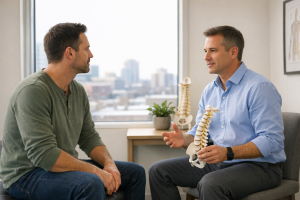
Appointment processes vary among therapists and clinics, but patient-centred care should begin with a conversation rather than immediate treatment. You should have an opportunity to explain your symptoms, goals, relevant health history and concerns.
Health History and Goals
Be prepared to discuss when the pain began, whether it is improving or worsening, what activities affect it and whether symptoms travel into a leg. The therapist may also ask about numbness, tingling, weakness, sleep, work, exercise, previous episodes, medical conditions, medication and recent injuries.
It can help to identify a functional goal before the appointment. Instead of focusing only on making the pain disappear, consider what you want to do more comfortably, such as walking for 20 minutes, turning in bed, sitting at work or returning gradually to the gym.
Screening and Assessment
Where appropriate and within the therapist’s professional scope, the appointment may include observing comfortable movement, discussing tender areas or checking which positions feel safe. If the history suggests a condition that should be medically assessed, the therapist may postpone massage or recommend another appropriate evaluation.
No single movement test or tender point can identify every cause of low back pain. Screening is used to help guide safe care, not to provide certainty that is unsupported by the findings.
Consent, Positioning and Draping
Consent is an ongoing process. Before treatment begins, the therapist should explain the proposed areas and approach in understandable terms. You can ask questions, decline treatment to any area or change your mind at any time.
You can request lighter pressure, a different position, additional support, more coverage or a pause. Depending on the approach, treatment may be provided over clothing. When skin is exposed, appropriate draping should maintain privacy and expose only the area being treated with consent.
Low back treatment does not always require lying face down. Side-lying, supported face-up or seated positions may be more comfortable. Treatment also does not have to focus directly on the most painful point. With permission, the therapist may discuss nearby regions such as the hips or upper back when relevant to comfort and movement.
Communication During Treatment
Pressure should remain tolerable and consistent with the agreed goal. You do not need to endure sharp, burning, electric or increasingly intense pain for massage to work. Let the therapist know about unexpected symptoms, spreading pain, numbness, tingling, dizziness or discomfort with positioning.
Near the end, you may review how you feel and whether a relevant movement or task has changed. This is not a pass-or-fail test. It provides information for deciding whether to continue, modify the approach, focus on self-management or seek another assessment.
If you would like to explore whether massage fits your symptoms and goals, you can book a massage therapy appointment with Human Integrated Performance. The initial conversation is an opportunity to discuss safety, preferences and realistic expectations before deciding on treatment.
Is One Type of Massage Best for Low Back Pain?
No named massage style has been shown to be universally best for low back pain. Technique selection should account for symptom irritability, goals, health history, comfort and response. Labels can also overlap in practice, so the therapist’s reasoning and ability to adapt may matter more than the name of the method.
Relaxation-Oriented or Swedish Massage
This approach often uses broad, flowing movements and lighter to moderate pressure. It may suit someone seeking general comfort, reduced guarding or a less intense experience. Gentle treatment is not inherently less therapeutic than firm treatment.
Therapeutic and Deep Tissue Approaches
Therapeutic massage is a broad term for goal-directed treatment. Deep tissue work generally refers to slower or firmer techniques intended to affect deeper layers, but definitions vary. Deep pressure is not necessary for every person and is not automatically more effective.
Highly irritable symptoms, bruising risk, reduced sensation or certain health conditions may call for modified pressure or a different approach. More post-treatment soreness does not prove that more progress was made.
Myofascial and Trigger-Point Approaches
These approaches may use sustained or focused pressure on sensitive tissues. Some people find them comfortable and helpful; others do not. Tender areas can be clinically relevant without representing a single cause that must be released. Claims that a technique permanently breaks up tissue, realigns the spine or removes all trigger points go beyond what can be concluded from a typical response to massage.
Effective massage does not need to hurt. Mild tenderness may be acceptable when you understand and agree to it, but the therapist should adapt if pressure causes guarding, sharp pain or neurological symptoms.
Low Back Pain, Leg Symptoms and Sciatica
Sciatica generally describes pain following the distribution of the sciatic nerve, often into the buttock and leg. People may also experience tingling, numbness or weakness. Not every leg symptom is sciatica, and not every case has the same cause.
What Massage May and May Not Do
Massage may ease secondary muscle discomfort or help a person feel more comfortable while an appropriate care plan addresses the broader presentation. Evidence specifically supporting massage for low back pain with nerve-related leg symptoms is less clear than evidence for uncomplicated non-specific low back pain.
Massage should not be described as decompressing, realigning or releasing a nerve. It cannot be assumed to correct a disc-related problem or another source of nerve irritation. Symptom relief after massage does not confirm that nerve compression has resolved.
When Leg Symptoms Need Assessment
Seek timely clinical assessment for new or worsening leg numbness, persistent tingling, altered walking or loss of strength. Rapidly progressive weakness, saddle-area numbness or new bladder or bowel dysfunction requires emergency assessment. Severe symptoms affecting both legs also warrant urgent attention.
If leg pain is stable and there are no urgent warning signs, a qualified clinician can help determine whether massage is reasonable for comfort or whether another assessment should take priority.
What You May Notice After Massage
Some people notice short-term ease of movement, reduced stiffness, relaxation or a change in pain. Others notice little difference. Mild temporary tenderness can occur, particularly after unfamiliar or firm treatment, but reactions vary and soreness is not required for benefit.
Any mild response should trend towards settling rather than escalating. Contact the therapist to review the plan if soreness is stronger than expected, interferes substantially with normal activity or persists rather than improving. New weakness, spreading numbness, severe worsening pain, fever, loss of bladder or bowel control, or saddle-area numbness should not be dismissed as a normal massage reaction. Seek the appropriate medical or emergency assessment.
Track What Matters
Pain intensity is only one measure. Consider whether you can:
- Sleep or change position more comfortably.
- Walk, sit or stand for longer.
- Complete work and household tasks with less disruption.
- Return gradually to exercise or recreation.
- Feel less guarded or fearful during movement.
- Use fewer activity restrictions while remaining within a manageable range.
A short-lived improvement can still be useful, but it should contribute to a meaningful goal rather than becoming the only reason for repeated appointments.
How Often Should You Book Massage for Low Back Pain?
There is no evidence-based schedule that applies to everyone. Research studies use varied appointment frequencies, making it difficult to identify one ideal dose. Timing may depend on symptom severity, response, goals, availability, cost, other care and personal preference.
A reasonable plan includes a defined review point. Before committing to an open-ended schedule, agree on what improvement would look like and when progress will be reconsidered. Questions to review include:
- Did the appointment produce a useful change in comfort or function?
- How long did any benefit last?
- Did it help you participate in activity or another part of recovery?
- Were there unwanted reactions?
- Would modifying pressure, positioning or timing make sense?
When benefit is absent, repeatedly brief or diminishing, simply adding more sessions may not be the best next step. The plan may need to change, pause or include another appropriate assessment. Worsening or newly different symptoms should be reassessed rather than treated through automatically.
What Else Can Support Recovery From Low Back Pain?
Massage can complement recovery, but most uncomplicated low back pain care should also encourage safe, sustainable activity. The goal is not to force painful movement or ignore concerning symptoms. It is to avoid unnecessary loss of capacity while symptoms settle.
Keep Moving Where Appropriate
For uncomplicated low back pain, prolonged bed rest is generally not recommended. Short periods of rest may be useful during a flare, but extended inactivity can make returning to normal tasks more difficult. Comfortable walking, changing position and continuing tolerable daily activities are often reasonable.
Use symptoms as information rather than as an automatic stop signal. A temporary, manageable increase during or after activity does not always indicate damage, but a major or sustained worsening suggests that the dose should be adjusted. New neurological or systemic symptoms require assessment.
Modify Rather Than Avoid Everything
Temporary changes can help you remain involved in work, exercise and daily life. You might reduce lifting volume, split one long task into shorter periods, vary sitting and standing, shorten a workout or choose a comfortable range of motion. As symptoms become more manageable, activity can be increased gradually.
Pacing differs from avoiding all activity. Pacing uses planned, repeatable doses that build confidence and capacity without repeated boom-and-bust cycles. The right starting point is individual.
Consider Exercise and Broader Clinical Support
Exercise can support strength, endurance, movement confidence and return to valued activities. There is no single best exercise for every person with low back pain. An individualized plan may be useful when symptoms persist, recur frequently, limit important activities or create uncertainty about how to progress safely.
Another clinical assessment may also be appropriate when the diagnosis is unclear, neurological symptoms are present, pain is not progressing or work and sport demands require a structured return plan. Massage can remain a supportive component when it has a clear purpose within that broader plan.
Account for Sleep, Stress and Recovery
Pain is influenced by more than local tissue sensitivity. Poor sleep, stress, workload, low mood and fear of movement can amplify symptoms or reduce recovery capacity. This does not mean that pain is imagined. It reflects how physical, psychological and social factors interact within the nervous system and daily life.
Simple strategies may include maintaining a regular sleep routine, changing uncomfortable positions as needed, planning recovery around demanding work or training, and using relaxation practices that feel helpful. When stress, mood or sleep difficulties are substantial, discussing them with an appropriate health professional can be part of comprehensive back pain care.
How to Decide Whether Massage Is a Good Fit
Massage may be worth considering when urgent concerns have been excluded, you are comfortable with touch-based treatment and you have a practical goal for care. A good plan should respect your consent, adapt to your response and avoid promises that one technique will cure or permanently prevent low back pain.
Before proceeding, consider asking:
- What is the goal of this approach?
- How will pressure and positioning be adapted to my comfort?
- What change should we monitor between appointments?
- When will we review whether massage is helping?
- What symptoms would mean I should seek another assessment?
- How can treatment support activity and self-management?
Massage is not the right first choice for every episode, but it may provide useful short-term support for some people. The most helpful care is not defined only by what happens on the treatment table. It should help you understand your options, participate in decisions and move towards meaningful activity with greater confidence.
If you are looking for balanced, consent-based support for low back pain in Edmonton, you can book a massage therapy appointment with Human Integrated Performance to discuss your symptoms, goals and whether massage is an appropriate next step.