ACL rehabilitation is a progressive, individualized process that may take place before surgery, after ACL reconstruction or as part of non-surgical management. Physiotherapy may address pain and swelling, knee movement, walking, strength, balance, movement control and confidence. The plan should also reflect what you need to do at home, work, school, recreation or sport.
Time since injury or surgery matters, particularly when healing tissue must be protected. However, the calendar is only one part of decision-making. Surgical instructions, associated injuries, symptoms, functional testing and the physical demands of your goals can all influence when an activity is introduced.
If you are looking for ACL rehabilitation physiotherapy in Edmonton, understanding these pathways and milestones can help you participate in decisions, ask informed questions and recognize when medical review may be needed.
ACL Rehabilitation: The Short Answer
The anterior cruciate ligament, or ACL, helps control movement between the thigh bone and shin bone and contributes to knee stability. An ACL injury can affect more than sport. It may change how confidently someone walks on uneven ground, uses stairs, carries equipment, works in a physical role or participates in family and recreational activities.
ACL rehabilitation aims to restore useful knee function while respecting tissue healing and the person’s circumstances. Depending on the stage of recovery, priorities may include:
- Reducing pain and swelling.
- Restoring knee extension and gradually improving flexion.
- Rebuilding quadriceps and lower-limb strength.
- Improving walking, balance and movement control.
- Preparing for work, recreation, running or sport-specific demands.
- Rebuilding confidence in the knee.
Physiotherapy can be relevant whether surgery is planned, has already occurred or is not currently part of the plan. Current clinical guidance supports progressive rehabilitation in each setting, but it does not support applying one universal protocol to everyone. Two people with similar-looking injuries may progress differently because of associated knee damage, surgical procedures, symptoms, baseline capacity and personal goals.
Three Possible ACL Rehabilitation Pathways
An ACL tear does not automatically determine one treatment pathway. Decisions are usually made with input from the patient, physician or surgeon and physiotherapist. Factors may include knee instability, meniscus or cartilage injury, activity demands, general health, personal preferences and how the knee responds to rehabilitation.
Rehabilitation Before ACL Reconstruction
Physiotherapy before surgery is sometimes called preoperative rehabilitation or prehabilitation. The emphasis is not on proving that someone is ready for surgery by a fixed date. It is generally on improving the condition of the knee and the person’s overall capacity within medical guidance.
Common priorities include settling significant swelling, restoring comfortable knee extension, improving quadriceps function and normalizing walking as much as possible. Strength and general conditioning may also be developed when appropriate. The surgeon should be informed if the knee remains markedly swollen, cannot straighten, repeatedly gives way or develops new mechanical symptoms.
Rehabilitation After ACL Reconstruction
Postoperative rehabilitation begins with the surgeon’s instructions. Weight-bearing, bracing, range-of-motion limits and exercise progression may vary with graft choice, surgical technique and any additional procedure. A meniscus repair, cartilage procedure or treatment of another ligament can meaningfully change the plan.
Early care commonly focuses on protecting healing tissue, controlling swelling, recovering knee extension, reactivating the quadriceps and improving walking. Later stages progressively develop strength, power, endurance, jumping, direction changes and task-specific capacity. The sequence is adjusted according to the knee’s response and relevant surgical precautions.
Rehabilitation Without Reconstruction
Some people pursue structured rehabilitation without ACL reconstruction. This may be considered when the knee functions adequately for the person’s intended activities, when instability is limited, when surgical risks or preferences favour non-surgical care, or while the longer-term decision remains open.
This pathway is still active rehabilitation. It may involve strength, balance, agility, conditioning and gradual exposure to meaningful activities. Repeated instability, persistent limitations or changing goals should prompt reassessment rather than an assumption that the original plan must remain unchanged.
Human Integrated Performance provides physiotherapy support in Edmonton within a collaborative care setting. For an ACL injury, that collaboration may include respecting surgical directions, sharing relevant findings with medical providers and aligning rehabilitation with the patient’s daily and performance goals.
What to Expect at an Initial Physiotherapy Assessment
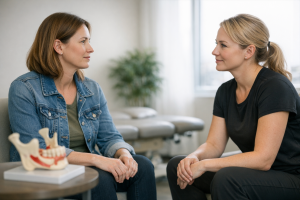
The first appointment is intended to establish a safe starting point. Not every test is suitable during an acutely painful stage or soon after surgery, so the assessment should be adapted rather than forced.
History and Medical Information
Your physiotherapist may ask how the injury occurred, whether the knee swelled quickly, whether it locks or gives way, and what has changed since the injury. Relevant health conditions, medications, previous knee problems, work demands, activities and recovery goals may also be discussed.
If available, bring your surgical report, postoperative instructions, imaging report, brace or mobility-aid directions and medication list. Imaging is only one part of the picture, but medical and surgical details can reveal precautions that should shape rehabilitation.
Physical and Functional Assessment
Depending on the stage of care, the physiotherapist may assess:
- Pain, swelling and tenderness.
- The ability to straighten and bend the knee.
- Quadriceps activation and other lower-limb strength.
- Walking pattern and use of crutches or a brace.
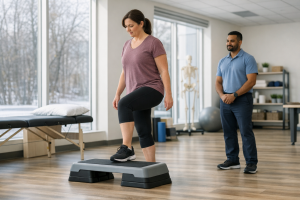
- Balance, squatting, stepping or other functional movements.
- Patient-reported function, confidence and symptoms.
Higher-demand tests, including hopping, running or forceful ligament testing, may be inappropriate initially. The first plan might therefore be simple: a small number of exercises, guidance on daily activity and a way to monitor the knee’s response. Exercises can become more demanding as the assessment supports progression.
How Progress Is Assessed Instead of Relying on the Calendar Alone
Time-based precautions remain important after surgery because graft tissue and associated repairs need time to heal. Yet reaching a particular week does not automatically mean that the knee is prepared for running, jumping or sport.
Criteria-based rehabilitation combines time and tissue-healing considerations with clinical and functional findings. Measures may include:
- Symptoms: Is pain manageable, and does swelling remain stable after activity?
- Range of motion: Can the knee straighten adequately, and is flexion progressing as expected?
- Muscle function: Can the quadriceps produce and sustain force without the knee giving way?
- Movement quality: Can the person control stepping, squatting, landing or deceleration tasks?
- Task capacity: Can the knee tolerate the volume and intensity needed for the next activity?
- Readiness: Does the person feel prepared, and is fear changing how they move?
These findings should be interpreted together. A single strength score, hop test or pain rating cannot represent every demand someone will face.
Understanding Flare-Ups
A mild, short-lived increase in symptoms after a new exercise does not always mean that damage has occurred. It may indicate that the dose was more than the knee currently tolerates. The useful questions are how intense the response was, whether swelling increased, how long it lasted and whether function returned to its recent baseline.
Marked swelling, repeated giving way, worsening pain or a sustained loss of motion warrants reassessment. The next step may be to reduce exercise volume, change the movement, allow more recovery or seek medical input. Modification is part of responsive rehabilitation, not necessarily a setback.
Common ACL Rehabilitation Goals and Exercise Progressions
Exercise selection depends on assessment findings and medical directions. The following priorities describe common areas of care, not a home protocol for an unassessed injury.
Managing Pain and Swelling
Relative rest, appropriate movement, load adjustment and measures recommended by the medical team may help manage symptoms. Complete inactivity is not routinely the long-term goal, but activity must remain appropriate for the injury or surgical stage. Persistent or increasing swelling can inhibit quadriceps function and may signal that current loading needs review.
Restoring Knee Motion
Recovering knee extension is often monitored closely because difficulty fully straightening the knee can affect walking and quadriceps use. Flexion is generally progressed according to symptoms and any surgical limits. Forceful stretching is not automatically better, especially when a repair or postoperative instruction restricts motion.
Rebuilding Strength
Early exercises may emphasize quadriceps activation and controlled loading. Progression can include resistance exercises for the quadriceps, hamstrings, hips and calves, along with trunk conditioning. Resistance, range, speed and total volume may be increased separately so the knee is not challenged in every way at once.
Strength work should eventually reflect the person’s goals. Someone returning to desk-based work, a construction role, hiking and competitive field sport will have different capacity requirements even if each person sustained an ACL injury.
Walking, Balance and Movement Control
Walking practice may involve gradually changing weight-bearing, mobility aids or brace use in accordance with medical instructions. The goal is not simply to stop using crutches quickly; it is to walk safely and with adequate control.
Balance exercises may progress from stable, predictable positions to more dynamic tasks. Later work can include stepping, single-leg control, landing, acceleration and deceleration. The physiotherapist may change the surface, speed, direction, resistance or cognitive demand, but only when the underlying task is performed with suitable control.
If your exercises remain unusually painful, produce increasing swelling or no longer relate to your goals, discuss the response with your physiotherapist. An individualized reassessment can clarify whether the dose, technique or overall plan should change.
Rebuilding Daily Activities Before Returning to Sport
Daily function deserves attention even when sport is the eventual goal. Comfortable walking, standing, stairs and household tasks provide meaningful information about the knee’s current capacity.
Walking, Stairs and Home Tasks
Walking may first progress through short, level routes before longer distances, hills or uneven surfaces. Stair ability depends on motion, strength and control; going down stairs can remain challenging because the quadriceps must control the body as the knee bends. Squatting, kneeling and carrying should be introduced according to symptoms, surgical restrictions and real-life needs.
Work and School
A return plan should account for commuting, prolonged sitting or standing, ladders, lifting, uneven terrain and the ability to take breaks. A person may be ready for modified duties before full duties. Students may need plans for campus distances, crowded stairs, physical education or carrying materials.
Activity increases are often easier to interpret when one variable changes at a time. For example, increase walking duration before adding hills and a loaded backpack. Tracking pain, swelling, fatigue and function later that day and the next morning can help guide the next adjustment.
From Running to Jumping, Pivoting and Sport
Running, jumping, cutting and competition are separate stages. Being able to jog does not establish readiness to absorb a hard landing, decelerate unexpectedly or react to another player.
Beginning a Running Progression
Before running, assessment may consider knee motion, swelling, pain, walking mechanics, single-leg control and lower-limb strength. The person also needs enough capacity to tolerate repeated impacts. Running may start with manageable intervals and predictable conditions, followed by gradual changes in duration, speed and terrain.
Jumping and Direction Changes
Jumping may progress from two-leg take-offs and landings to single-leg tasks, repeated efforts and different directions. Deceleration and change-of-direction training can begin in planned settings before advancing to faster, reactive or sport-specific situations.
Testing may include strength measures, hop tasks, movement observation and repeated-effort testing. Comparing limbs can be informative, but limb symmetry has limitations. The uninjured side may also have lost strength, and similar scores do not prove that either leg meets the demands of the activity. Absolute capacity, movement strategy, symptoms and fatigue response matter too.
Psychological and Sport-Specific Readiness
Fear of reinjury can affect movement, participation and willingness to attempt higher-demand tasks. It should be discussed rather than dismissed. Graded exposure, clear testing and shared planning may help someone understand what the knee can currently do while identifying areas that still need preparation.
Return-to-sport decisions should integrate medical guidance, rehabilitation findings, the athlete’s perspective and the actual demands of the sport and position. Clearance for one level of activity is not a guarantee against future injury, nor does it automatically mean immediate readiness for unrestricted competition volume.
Why an ACL Rehabilitation Plan May Change
A changing plan does not necessarily mean recovery has failed. Modification may be appropriate when:
- Pain, swelling, motion or stability changes.
- A meniscus, cartilage or additional ligament injury affects loading.
- The surgeon provides procedure-specific precautions.
- Illness, poor sleep, stress or schedule barriers reduce recovery capacity.
- Work, recreation or sport goals change.
- Testing identifies a strength, endurance or movement-control gap.
Patients can support communication by describing when symptoms began, what activity preceded them, whether swelling changed and how long the effects lasted. A physiotherapist may communicate with the physician or surgeon when progress conflicts with expected precautions, new medical concerns arise or clarification is needed about an associated procedure.
When to Contact Your Care Team or Seek Urgent Medical Help
After an injury or operation, follow the instructions provided by your surgeon or medical team. Those directions take priority over general online education.
Contact the Surgical or Medical Team Promptly
Seek timely advice if you experience worsening wound redness, warmth or drainage; fever or feeling increasingly unwell; a substantial increase in pain or swelling; a new inability to straighten the knee; repeated giving way; or an unexpected loss of function. A new injury, a knee that becomes mechanically locked or symptoms that are not settling as expected also warrant assessment.
New or increasing calf pain, tenderness or one-sided swelling requires prompt medical attention because these can be associated with a blood clot, although they can have other causes. Do not try to diagnose the cause yourself.
Seek Emergency Assessment
Call 911 for chest pain, sudden shortness of breath, coughing blood, fainting or other severe symptoms that could indicate a cardiopulmonary emergency. Urgent assessment is also appropriate for a foot that becomes cold, pale or blue, rapidly increasing severe pain, or major new numbness or weakness below the knee.
In Alberta, Health Link at 811 can provide guidance when you are unsure where to seek care, but it does not replace 911 for an emergency. Depending on the situation, appropriate options may include the surgical team, a physician, urgent care or an emergency department.
Reducing Future ACL Injury Risk
No program can prevent every ACL injury or reinjury. Sport includes unpredictable contact, speed and environmental factors. Preparation can nevertheless address modifiable contributors to performance and injury risk.
Evidence-informed prevention programs commonly combine:
- Progressive lower-limb and trunk strengthening.
- Balance and neuromuscular training.
- Practice with landing and deceleration mechanics.
- Planned and reactive change-of-direction tasks.
- Gradual exposure to training and competition demands.
- Structured dynamic warm-up activities.
The content should match the person’s sport, role and current capacity. A soccer player, skier and recreational runner do not need identical preparation. Risk-reduction work also should not stop abruptly at clearance. Maintaining strength, conditioning and movement practice can support long-term participation.
Accessing ACL Rehabilitation Physiotherapy in Edmonton
When comparing physiotherapy options, look beyond a generic postoperative timeline. A useful plan should account for your medical instructions, current findings and specific goals. Consider asking:
- How will pain, swelling, motion and strength be monitored?
- Which criteria will be considered before running or higher-demand activity?
- How will my work, school or caregiving responsibilities affect the plan?
- How will exercises be progressed if I am aiming to return to sport?
- When would you communicate with my physician or surgeon?
- What should I do if symptoms increase between appointments?
Coverage and Referrals in Alberta
Payment arrangements vary. Some people use employer or personal health benefits, while others may qualify for funding through a workplace injury claim, motor vehicle insurance, a surgical pathway or specific publicly funded services. Eligibility, referral rules, visit limits and documentation requirements can change and should be confirmed directly with the payer and clinic before treatment.
A medical referral may not be required simply to arrange a private physiotherapy assessment, but an insurer, benefit plan or surgical program may require one for payment or coordination. Alberta Health Services and Health Link can provide current information about publicly funded options and local access. Confirming the details in advance can reduce unexpected costs.
Preparing for the First Appointment
Bring relevant reports and instructions, a list of medications, comfortable clothing and any brace or mobility aid you use. Think about the activities that matter most to you and the tasks that currently feel limited. Useful goals are not restricted to returning to sport; walking the river valley, completing a work shift or managing stairs confidently can be equally meaningful.
ACL recovery can involve uncertainty, especially when progress does not follow a simple calendar. Collaborative physiotherapy can help translate medical precautions and assessment findings into manageable next steps for daily life, work, recreation or sport.
If you would like an individualized starting point, you can book a physiotherapy assessment with Human Integrated Performance. Your physiotherapist can review your injury or surgical instructions, assess current function and help develop a gradual plan aligned with your goals.